Diagnostic Use
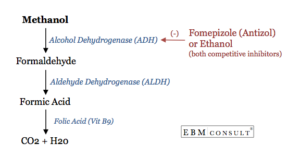
Methanol is metabolised to formaldehyde and formic acid. Ethanol and fomepizole are competitive inhibitors of this conversion step and can be used to prevent accumulation of toxic metabolites.
Initial ingestion can be associated with increased osmolar gap, which later develops into an anion gap due to metabolism to formic acid. An osmolar gap within reference limits does not necessarily exclude the presence of osmotically active substances. Formaldehyde and formic acid are not measured.
Initial inebriation symptoms may be deceptively mild after ingestion, but usually progress (after a variable latent period) to visual symptoms (often first), GI symptoms/abdominal pain, tachypnoea/tachycardia, seizures/neurological sequelae, coma and death. Long term neurological sequelae can take days to weeks to develop.
Symptoms are more likely to be delayed if ethanol is also ingested. Regardless, urgent medical attention under expert management/guidance is indicated if suspicious to prevent irreversible sequelae.
NOTE: Management guidance including criteria for starting an antidote (ethanol/fomepizole) in poisoning with methanol (or ethylene glycol) poisoning has been updated in 2023. Clinicians should discuss with a toxicologist. The New Zealand (NZ) National Poison Centre phone number is 0800 764 766, or website http://toxinz.com
In Te Toka Tumai (Auckland District), consult local ED experts and refer to management guidance on intranet.
Interpretation
General guidelines for treatment (updated 2023) NOTE: Specific cases should be discussed with a toxicologist
Fomepizole is indicated if:
Either: Patient has a serum methanol concentration 6.2 mmol/L
OR
Either: Patient has a documented recent history of methanol ingestion with increased osmolal gap of >10mOsm/L.
(Osmolal gap = measured serum osmolarity (measured by freezing point depression in the lab) minus
calculated osmolality = 2x[Na+] + [glucose] + [urea] + ethanol (if present) (all in mmol/L)
OR
Both: Patient has a history of methanol ingestion; AND at least two of the following:
– Arterial pH < 7.3; or
– Serum bicarbonate < 20mmol/L; or
– Osmolal gap > 10mOsm/L; or
– Urinary oxalate crystals present (only in ethylene glycol poisoning cases)
Treatment end point is when the patient?s methanol concentration is below 6.2 mmol/L, symptoms have resolved AND pH has normalised.
Antidote treatment should not be withheld while awaiting methanol quantitation
If ethanol is used, the aim is to maintain serum ethanol concentrations between 22 – 33 mmol/L.
Reference:
N. Engl. J. Med. 2018; 378:270-80
Uncertainty of Measurement
16% at a level of 20 mmol/L