Diagnostic Use
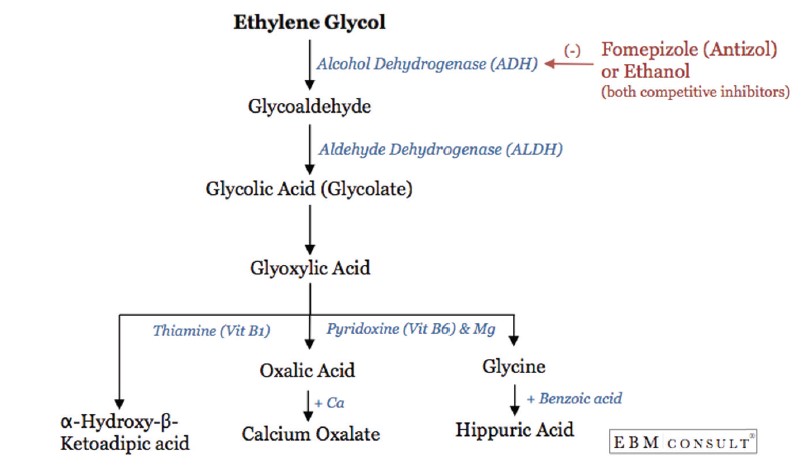
Glycolic acid spot test should be requested to confirm ethylene glycol poisoning. At LabPLUS, the glycolic acid spot test is available 24hrly as a qualitative screening test. It can be performed within short notice and a result is usually available in around 2–3 hours.
A positive result indicates the presence of glycolic acid, a metabolite of ethylene glycol. This test does not quantify the level of ethylene glycol or glycolic acid. A false negative result can occur when there is concomitant ethanol consumption (which inhibits ethylene glycol metabolism) especially if there is a short period between ingestion and testing.
Ethylene glycol / glycolic acid quantification by GC‑MS (Gas chromatography mass spectrometry) is generally not available outside normal working hours as it involves complex analytical procedures. If testing outside of hours will change acute management, it may be possible to arrange urgent testing.
Interpretation
NOTE: Specific cases should be discussed with a toxicologist.
As a very rough guide, serum glycolic acid > 10 mmol/L (76 mg/dL) corresponds to bicarbonate of < 20 mmol/L and a blood pH of < 7.25.
Ethylene glycol poisoning can be associated with raised lactate, however glycolic acid can also cause false lactate elevation, especially on point of care (“POCT”) instruments, due to the glycolic acid cross-reacting as a substrate for the lactate oxidase method used. The interference is usually much less, but not entirely absent on lactate measurements using main laboratory analysers. Finding a “lactate gap”, the difference between POCT and laboratory lactate results, can sometimes be a clue to the presence of glycolate.
Test Method
Principle: Glycolic acid spot test, Ethylene glycol / glycolic acid quantification by GC-MS (Gas chromatography mass spectrometry)
Limitations / Interference
NOTE: If the patient presents very early or if there is concurrent ingestion of ethanol or treatment by ethanol/fomepizole then a negative glycolic acid spot test result does not exclude ethylene glycol poisoning.
As a toxic metabolite of ethylene glycol, there is a lag phase for glycolic acid to appear in circulation, especially if ethanol is also present (which retards the metabolism of ethylene glycol).
General guidelines for treatment (updated 2023) - NOTE: Specific cases should be discussed with a toxicologist
Possible false lactate elevation on point of care instruments due to glycolic acid.
Ethylene glycol poisoning can be associated with raised lactate, however glycolic acid can also cause false lactate elevation, especially on point of care (“POCT”) instruments, due to the glycolic acid cross-reacting as a substrate for the lactate oxidase method used.
The interference is usually much less, but not entirely absent on lactate measurements using main laboratory analysers.
Finding a “lactate gap”, the difference between POCT and laboratory lactate results, can sometimes be a clue to the presence of glycolate.
The glycolic acid spot test also cannot reliably be used to determine when to stop ethanol/fomepizole or haemodialysis treatment.
It is generally not available outside normal working hours as it involves complex analytical procedures. (GC‑MS availability limitation)
Uncertainty of Measurement
Ethylene Glycol 12%
Glycolic acid 26%
Conversion factors:
Ethylene glycol: mg/dL = mmol/L x 6.2
Glycolic acid: mg/dL = mmol/L x 7.6