Testing Laboratory
Auckland Te Toka Tumai | Auckland HospitalDepartment
Chemical Pathology
Delphic Registration Code (Alpha Code)
BGE
Test Code (Numeric Code)
0340
Laboratory Handling
Phlebotomy
Arterial or venous blood in a heparinised blood gas syringe,
or a micro-sample: collect one heparinised capillary tube.
For accurate results any bubbles or froth must be removed immediately before gentle mixing of the syringe (rolling for at least 20 seconds).
Mix well.
Put patient label on the barrel of syringe, not the plunger.
Transport
Transport to laboratory without delay.
Samples (in plastic syringes transported at room temperature) are analysed promptly, but should be reported within 30 minutes to minimise the effect of oxygen diffusion. Ice does not improve reliability of results with plastic syringes.
Sample Stability
-
Synonyms
Blood Gases, Capillary Blood Gas, Arterial Blood Gas, Venous Blood Gas, Acid-Base, pH, Carbon Dioxide, CO2, pCO2, Oxygen, O2, pO2, A-a gradient, Base Excess
Turnaround Time
60 minutes
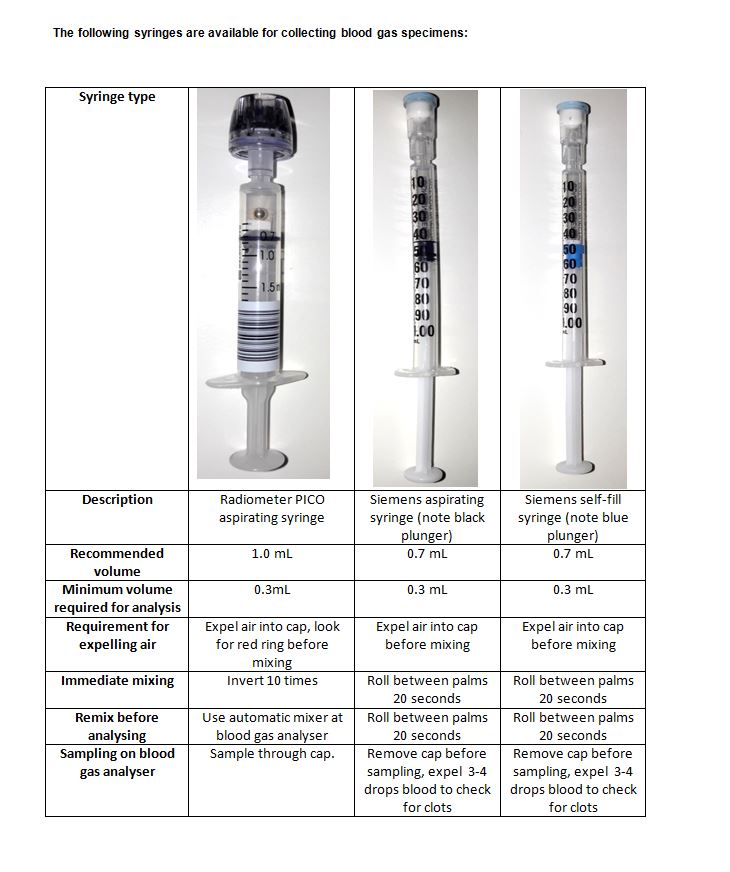
See Resources: Blood gas specimens - collection syringe types.
Specimen Type
- Whole Blood
Specimen Requirements
Tube/Container Type:
Preferred
- Blood Gas Syringe
Preferred Sample Volume (ml)
1
Minimum Sample Volume (ml)
0.7
No of Samples Required
1
Paediatric Specimen Requirements
Tube/Container Type:
Preferred
- Paediatric Blood Gas Capillary Tubes
Additional Specimen Information
For accurate results any bubbles or froth must be removed immediately before gentle mixing of the syringe (rolling for at least 20 seconds).
Samples (in plastic syringes transported at room temperature) are analysed promptly, but should be reported within 30 minutes to minimise the effect of oxygen diffusion. Ice does not improve reliability of results with plastic syringes.
Capillary samples are very dependent on the quality of specimen collection, including the maintenance of anaerobic conditions during the procedure, to produce reliable results. pO2 is not reported on capillary specimens.
See link 2 'Blood gas specimens collection syringe types' under Additional Information below for more details.
Last updated: 27/07/2026