Diagnostic Use
6-thioguanine nucleotides (6-TGNs) are the active metabolites of the cytotoxic drugs Azathioprine, Mercaptopurine and Thioguanine. Measurement of 6-TGNs helps to confirm therapeutic concentrations and to avoid toxicity. It takes about 4 weeks for 6-TGN concentrations to stabilise after initiating or altering the dose of thiopurine.
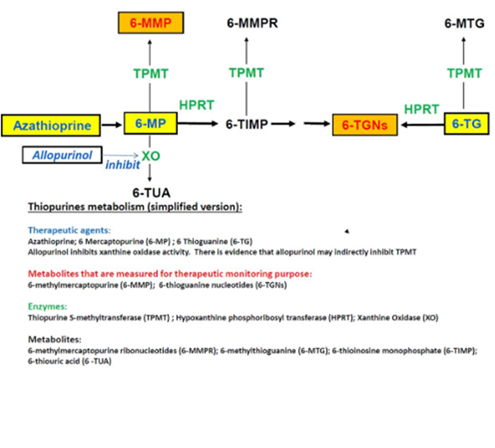
Note that this test is separate and distinction from TPMT activity testing, which is recommended before starting the aforementioned cytotoxic drugs. TPMT is responsible for metabolising 6-mercaptopurine to 6-MMP and 6-thioguanine to 6-MTG. Wide genetic differences in TPMT activity exist in the population. Patients with low levels of TPMT are at higher risk of toxicity, and will require lower doses of these cytotoxics. The level of TPMT can be measured in red blood cells (see TPMT entry in LabPlus test guide).
Interpretation
Figure 1: Simplified version of Thiopurines metabolism
Metabolites measured for therapeutic monitoring: 6-methylmercaptopurine (6-MMP) and 6-thioguanine nucleotides (6-TGNs).
Ref: Khan A et al. New Zealand Society of Gastroenterology Guidelines on Therapeutic Drug Monitoring in Inflammatory Bowel Disease. NZMJ 2019; 132(1491): 46-62.
Reference Intervals
6-TGN :
A. For patients on Azathioprine or 6 Mercaptopurine:
< 235 pmol/8 x 10(8) RBC: below the therapeutic range for inflammatory bowel disease, may indicate a reduced response to therapy or non-compliance
235 to 450 pmol/8 x 10 (8) RBC: associated with greater efficacy in management of inflammatory bowel disease
> 450 pmol/8 x 10(8) RBC: increased risk of significant leucopenia and myelotoxicity but it can also occur at lower concentrations of 6-TGN
B. For patients on Thioguanine:
Unlike patients on Azathioprine or 6 Mercaptopurine, patients on 6 thioguanine (or LANVIS) therapy generally have higher trough 6 TGNs levels. A level of between 800 to 1200 pmol/8×10(8) RBC should be targeted. Nodular regenerative hyperplasia in liver nowadays is considered rare especially when low dose, at around 0.3mg/kg/day is used. Its clinical course is often benign and pathology reversible. However, if liver enzymes especially ALP is raised by 2 times, WBC is below 1x 10 9 /L, platelet counts fall significantly or there is histologically proven hepatotoxicity, TG therapy should be discontinued.
6-MMP:
It is an inactive metabolite and its levels do not correlate with therapeutic efficacy.
6-MMP > 5700 pmol/8 x 10(8) RBC correlates with increased risk for hepatotoxicity. High 6 MMP has also been associated with myelotoxicity.
Low 6-TGN and markedly high 6-MMP (i.e. if the ratio of 6-MMP to 6-TGN is >= 20, also known as “shunters”) is associated with an increased risk of poor response to therapy.
Consideration to introduce allopurinol and/or dose adjustments for “shunters” should be made only after discussion with the specialist involved with the patient’s care.
Test Method
High performance liquid chromatography with photodiode array detection (HPLC-PDA)
Uncertainty of Measurement
10% 6TGN level from 200 to 1500 pmol/8 x 10(8) RBC.
16% 6MMP level from 400 to 8000 pmol/8 x 10(8) RBC.