Diagnostic Use
Thiopurine methyltransferase (TPMT) is an enzyme involved in the metabolic pathway of cytotoxic medications such as Azathioprine and 6-mercaptopurine (6-MP). TPMT testing is recommended before starting such medications to help gauge the risk of adverse effects. (1-3)
Low TPMT activity reduces the conversion of 6-MP to 6-MMP (an inactive metabolite), and increases the relative conversion of 6-MP to 6-TGNs, the active metabolites. 6-TGNs are also metabolised by TPMT enzyme, which additionally leads to higher active 6TGN levels in TPMT deficient patients. Such patients are classified as poor metabolisers. Their prevalence is estimated to be 1 in 300. These patients have an extremely high concentration of 6-TGN if given a standard dose of thiopurine drugs and are at risk of rapid and severe bone marrow toxicity with leukopaenia. Alternative non-thiopurine therapy should be considered in this group of patients. If thiopurine drugs are used, they should be started at 10% of target dose. (2)
Very high TPMT activity increases the rate at which the active metabolite is inactivated and may lead to treatment failure.
Almost all TPMT activity in blood is present in red cells, and must be released by lysing the cells and measuring enzyme activity prior to analysis of the product (6MMP) using HPLC (high pressure liquid chromatography). The result is then adjusted using the haematocrit.
TPMT enzyme activity is genetically determined. Loss-of-function variants in TPMT gene cause low TPMT activity. This is inherited as a monogenic, autosomal co-dominant trait.
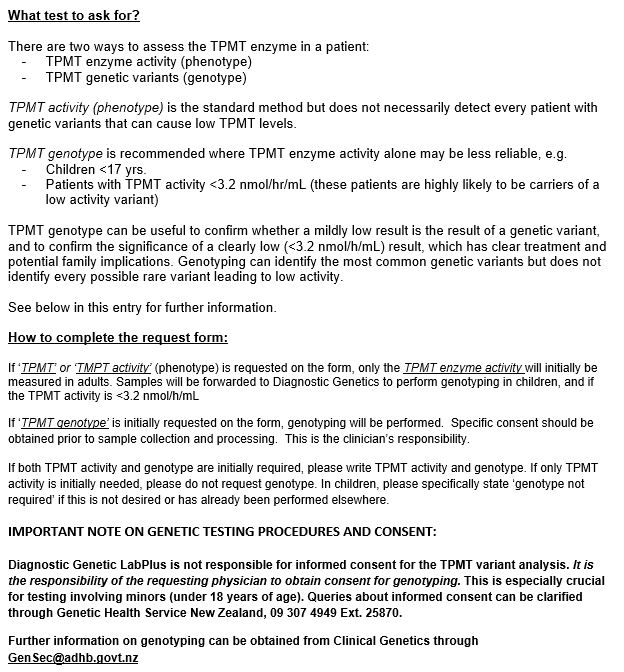
Genetic TPMT Analysis (Genotyping) is recommended in all patients with TPMT activity ≤ 3.2 nmol/h/mL and in all children under 17 years. It can is automatically performed when TPMT activity is low or when specifically requested.
The genetic analysis performed at LabPLUS covers the targeted region containing the three single nucleotide variants of the common inactivating TPMT alleles (TPMT2/3A/3B/3C) which account for over 90% of low activity phenotypes. Sometimes additional rare variants found in the sequenced exons may be identified, however other rare variants may still not be found. (5) Since genotyping does not identify all potential activity variants, it is not a completely reliable substitute for initial enzyme analysis in every case.
Please note that, as with any genetic test, there is the possibility of identifying sequence variants of uncertain significance (VUS). These can’t be used to support informed decision making in clinical management, so can lead to residual uncertainty.
Regardless of initial testing, all patients on TGN treatment require close monitoring.
Important note on consent for genetic testing:
Genetic testing requires specific consent from the patient. This is taken as given by the clinician at the time of genotype request, or if reflex genotyping is required. It is the responsibility of the clinician to discuss and consent the patient when discussing TPMT phenotyping.
TPMT Measurement in Children
TPMT levels in “wild type” children are slightly higher than adults, however the difference is not sufficiently great to affect interpretive cutoffs used. (7) However, in children with ALL treated by thiopurines there can be disease- and treatment-related effects. Older red cells, which tend to predominate with bone marrow failure at diagnosis, have lower TPMT than young red cells, so TPMT activity may be initially reduced and can rise as bone marrow activity improves with treatment. (6)
For this reason documentation of TPMT genotype is recommended before starting treatment and is performed on all requests for TPMT analysis in children.
Important note on consent for genetic testing in children (<18 years):
Genetic testing requires consent from the parents/legal guardians. This is taken as given by the clinician at the time of genotype request, or if reflex genotyping is required. It is the responsibility of the clinician to discuss and consent the family when discussing TPMT phenotyping.
Interpretation
TPMT activity in homozygous and heterozygous carriers of TPMT variant alleles.
Over 90% of homozygous or compound heterozygous variant carriers have significantly reduced TPMT activity at or below 3.2 nmol/h/mL. Conversely less than 2.5% of heterozygote carriers (who possess at least one wild type TPMT gene) have TPMT below this threshold. If not already requested, targeted genetic analysis of key exons in the TPMT gene should be performed on samples with TPMT activity in this range (<3.2nmol/h/mL). Consent is required.
The large majority of heterozygous variant carriers (who also carry one normal allele) have TPMT activity in the range 3.2-4.3 nmol/h/mL (intermediate metabolisers). Note, however, that correlation between genotype and phenotype is imperfect and there is significant overlap between heterozygote carriers and wild type patients. About 2/3 of patients in this range are variant carriers, but 1/3 prove to be “wild type” (with no low activity variants) on genotyping. Less than 10% of homozygous or compound heterozygous deficient patients have activity in this range . Genotyping is not automatically performed in this group, although can be separately requested.
Heterozygote carriers of variants are at increased risk of myelosuppression at standard doses of thiopurine drugs. Knowledge of the TPMT activity is useful in establishing the correct dose in such patients. Starting at 33-50% of target dose has been recommended in ?intermediate metabolisers. (2,3)
Monitoring of patients on treatment
Routine monitoring of FBC, LFT and TDM of thiopurine drug metabolites (TGN’s) is recommended for all patients on thiopurine drugs, regardless of enzyme activity. NZ Gastroenterology Society recommendations are for FBC, LFT weekly for a month, monthly for two months, then every 3 months if on stable dose, with ongoing monitoring for adverse effects 3 . Please also see 6-Thioguanine Nucleotides.
Sulfasalazine (Pentasa) treatment can be associated with a reduction in TPMT activity. Discontinuation of treatment can therefore lead to a modest increase in activity and fall in TGN levels.
Drugs and conditions leading to an increased proportion of young red cells, e.g. haemolysis, chronic blood loss, stem cell transplant, and responses to AZA or 6MP treamtent, can lead to a rise in TPMT activity.
Note that high TPMT does not necessarily predict a high level of MMP, and does not reliably predict a high MMP/TGN ratio (sometimes called a “shunting effect” and associated with reduced efficacy despite increasing TGN dose). This is because there are likely to be other additional “shunting” mechanisms leading to reduced efficacy, and it is still necessary to monitor TGN levels in patients on treatment. See also TGN entry in Testguide.
Please refer to the guidelines in the references for the details of dosage adjustments.
Recent Transfusion
TPMT activity is affected by red cell transfusion within the previous 3 months. This must be considered when interpreting TPMT activity results. Blood samples for TPMT activity should be taken prior to any transfusions or after 3 months, with careful dose escalation 3 . For post-transfusion samples earlier than this, TPMT genetic analysis can be arranged with the laboratory.
Reference Intervals
Reference TPMT activity >= 4.4 nmol/h/mL RBC
Borderline 4.4-4.6 nmol/h/mL
High likelihood of homozygous variant <=3.2 nmol/h/mL
If a sample requires further genetic testing it will be subject to the turnaround times of the genetics department and requires appropriate consent.
See also TGN (Thioguanine) entry in Testguide.
Test Method
High performance liquid chromatography with photodiode array detection (HPLC-PDA)
Limitations / Interference
Sulfasalazine (Pentasa) treatment can be associated with a reduction in TPMT activity. Discontinuation of treatment can therefore lead to a modest increase in activity and fall in TGN levels.
Drugs and conditions leading to an increased proportion of young red cells, e.g. haemolysis, chronic blood loss, stem cell transplant, and responses to AZA or 6MP treamtent, can lead to a rise in TPMT activity.
TPMT activity is affected by red cell transfusion within the previous 3 months. This must be considered when interpreting TPMT activity results. Blood samples for TPMT activity should be taken prior to any transfusions or after 3 months, with careful dose escalation 3 . For post-transfusion samples earlier than this, TPMT genetic analysis can be arranged with the laboratory.
Uncertainty of Measurement
14%